How to Half Double Crochet (hdc) for Beginners
If you have learned single crochet and you are ready for something with a little more height, the half double crochet is a wonderful next stitch to add…


If you have learned single crochet and you are ready for something with a little more height, the half double crochet is a wonderful next stitch to add to your toolkit. It builds directly on skills you already have, it works up noticeably faster than you might expect, and the fabric it makes is thick, squishy, and warm without being stiff. A lot of crocheters end up reaching for it more than any other stitch once they discover it. Let’s break it down together, one motion at a time.
Jump to section
What Is Half Double Crochet, and Where Does It Fit?
Half double crochet, abbreviated hdc, sits right in the middle of the two stitches you have probably already met: single crochet (sc) and double crochet (dc). In terms of height, hdc is taller than sc but shorter than dc. In terms of the fabric it creates, it lands somewhere in between too: it keeps a lot of the dense, squishy warmth that makes single crochet so good for cold-weather projects, but it works up considerably faster than sc because each stitch covers more height per motion.
That combination is exactly why hdc shows up so often in blankets, hats, and scarves. You get a fabric that feels thick and cozy, without spending as many hours on it as you would with all single crochet.
Before we start, a quick refresher on the abbreviations you will see below: yo (yarn over, wrapping the yarn around your hook), st (stitch), sc (single crochet), dc (double crochet), and hdc (half double crochet, the stitch we are learning today). You should already have a foundation chain and be comfortable holding your hook and yarn before you dive into this one.
The Half Double Crochet, Step by Step

The whole stitch happens in four small motions. Read through them once, then work them slowly on a practice swatch until your hands find the rhythm.
Step 1: Yarn Over First
Before you touch the next stitch, yarn over (yo). This is the detail that trips up the most beginners, because in single crochet you do not yarn over before inserting your hook, but in half double crochet you always do. Get this first motion locked in and the rest of the stitch falls into place.
Step 2: Insert Your Hook Into the Next Stitch
With the yarn still wrapped over your hook from step 1, insert your hook into the next stitch (st) of your row, going under both loops at the top of the stitch unless your pattern tells you otherwise.
Step 3: Yarn Over and Pull Up a Loop
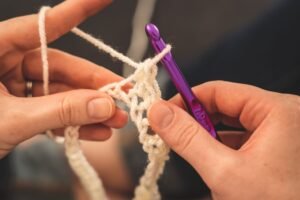
Yarn over again and pull the yarn back through the stitch. Stop and check your hook: you should now have 3 loops on your hook in total. This is the moment that defines a half double crochet, so it is worth pausing here the first few times to actually count them.
Step 4: Yarn Over and Pull Through All 3 Loops
Yarn over one more time, and pull that new loop through all 3 loops on your hook at once, in a single motion. You are left with 1 loop on your hook, and that is one complete half double crochet made.
Repeat these four steps across your row, working one hdc into each stitch (or wherever your pattern directs), and you will start to see that satisfying, slightly ridged hdc fabric build up.
The Turning Chain for hdc
At the end of each row, before you turn your work to start the next one, you need a turning chain to bring your hook up to the correct height for the next row. For half double crochet, patterns commonly use either of two conventions:
- Chain 2 and count it as the first stitch of the new row. With this method, when you get to the end of the next row, you work your final stitch into the top of that turning chain, since it is standing in for a real hdc.
- Chain 2 (or sometimes 1) and do NOT count it as a stitch. With this method, you skip working into the turning chain at the end of the row, and instead your first actual hdc of the row goes into the first real stitch.
Here is the important part: there is no single universal rule, so always follow what your specific pattern states. Patterns are usually explicit about this right at the start of the instructions, something like “ch 2, counts as first hdc” or “ch 2, does not count as a stitch.” When you are writing your own practice swatch with no pattern to follow, just pick one convention and stay consistent with it for the whole piece, since mixing the two mid-project is what causes stitch counts to drift.
The Third Loop Trick (A Nice Next-Step Tip)
Once you are comfortable with basic hdc, here is a detail worth knowing about, even if you do not use it right away. A half double crochet stitch actually has three loops sitting along its top edge, not two: the front loop, the back loop, and an extra horizontal loop that sits behind the usual two, sometimes called the “third loop” or the “back bump.”
On a normal hdc row, you work under the front and back loops and never touch that third loop, so it sits there unused, tucked behind your work. But if you deliberately work your next stitches into just that third loop instead, you get a distinctive ridged, knit-look texture that a lot of crocheters use for hdc-only “faux knit” projects, like beanies made to look machine-knit. It is not something you need for a first swatch, but it is a fun trick to keep in your back pocket for when you want a different texture from the exact same stitch.
A Simple Practice Swatch
To get the rhythm into your hands, try this small swatch:
- Chain 21.
- Row 1: Half double crochet into the 3rd chain from the hook (the first two chains act as your starting turning chain) and into each chain across. You should end the row with 20 hdc stitches total.
- Turn your work and chain 2 (this is your turning chain for the next row).
- Row 2 onward: hdc into each stitch across the row, following whichever turning-chain convention you have chosen for whether that ch-2 counts as a stitch.
- Repeat for 6 to 8 rows, then stop and look at your fabric. You should see a fairly dense, slightly textured swatch with visible horizontal rows.
Working a small swatch like this before starting a real project is genuinely worth the ten minutes. It lets you find your rhythm and catch mistakes on scrap yarn instead of on something you are hoping to wear.
Common Mistakes to Watch For
A couple of small slip-ups account for most of the trouble beginners run into with this stitch:
- Forgetting the starting yarn over. If you insert your hook into the stitch before yarning over, you have accidentally started a single crochet instead. If your hdc rows keep coming out shorter than expected, this is almost always the culprit. Get in the habit of yarning over as the very first motion, every single time, before your hook goes anywhere near the next stitch.
- Pulling through only 2 loops instead of all 3. This is the other common slip, especially for crocheters coming from single crochet, where pulling through 2 loops at a time is the norm. If you pull through just 2 loops on an hdc, you will end up doing something closer to an sc-with-extra-steps, and your stitch count and row height will both come out wrong. Always pause at step 3, actually look at your hook, and confirm you see 3 loops sitting there before you make that final pull-through.
If your swatch ever looks uneven or shorter than you expected, these two spots are the first place to check.
Enjoy the Speed
Half double crochet has a way of becoming a new favorite stitch once it clicks, mostly because it delivers that same soft, thick fabric you love from single crochet, but noticeably faster. Give yourself a few rows to find the rhythm of yo, insert, yo and pull up, yo and pull through all three, and soon your hands will do it without you even thinking about the steps. From there, a whole world of hdc hats, blankets, and scarves is wide open to you.
Frequently asked questions
What does hdc stand for and how tall is it compared to other stitches?
Hdc stands for half double crochet. It sits between single crochet (sc) and double crochet (dc) in height: taller than sc but shorter than dc.
How many loops should be on my hook during a half double crochet?
After you yarn over, insert your hook, and yarn over again to pull up a loop, you should have 3 loops on your hook. You then yarn over one more time and pull through all 3 loops at once to complete the stitch.
Does the turning chain count as a stitch?
It depends on the pattern. Some patterns have you chain 2 and count it as the first stitch of the row, while others have you chain 2 (or 1) without counting it as a stitch. There is no single universal rule, so always follow what your specific pattern states.
What is the “third loop” in half double crochet?
Every hdc stitch has three loops along its top edge: the front loop, the back loop, and an extra horizontal loop behind them called the third loop or “back bump.” Working into just that third loop creates a ridged, knit-look texture.
— NoraEvery pattern hand-tested