Why Crochet Can’t Be Made by a Machine (and How to Spot Fake “Crochet”)
Here's a fact that surprises almost everyone the first time they hear it: crochet (US term - the craft of creating fabric by looping yarn with a single…

Here’s a fact that surprises almost everyone the first time they hear it: crochet (US term – the craft of creating fabric by looping yarn with a single hook, abbreviated as “crochet” itself has no shorthand but individual stitches do, like sc for single crochet) is the one major textile craft that has never been successfully automated. Knitting machines have existed for centuries. Looms have woven fabric by machine since the Industrial Revolution. But true crochet, the kind made stitch by stitch with a hook, still comes only from human hands. If you have ever felt a little extra pride handing someone a crocheted gift, this is exactly why that pride is earned.
Jump to section
The Machines That Changed Everything – Except This One
Knitting was industrialized starting in 1589, when William Lee invented the stocking frame, a hand-cranked knitting machine. By the 1800s, powered knitting machines were producing sweaters, socks, and fabric by the mile. Weaving followed a similar path – the power loom, developed in the late 1700s and refined through the 1800s, turned weaving into a fully mechanized industry. Today, almost every knit t-shirt, sweater, and pair of socks you own was made on a machine, not by hand.
Crochet never made that jump. Despite more than a century of industrial textile innovation, no machine has ever been built that reproduces the actual mechanics of a crochet stitch. Every true crocheted item in the world, from a simple dishcloth to an elaborate lace shawl, was made one loop at a time by a person holding a hook.
Why a Machine Can’t Do What a Hook Does

What a Single Crochet Stitch Requires
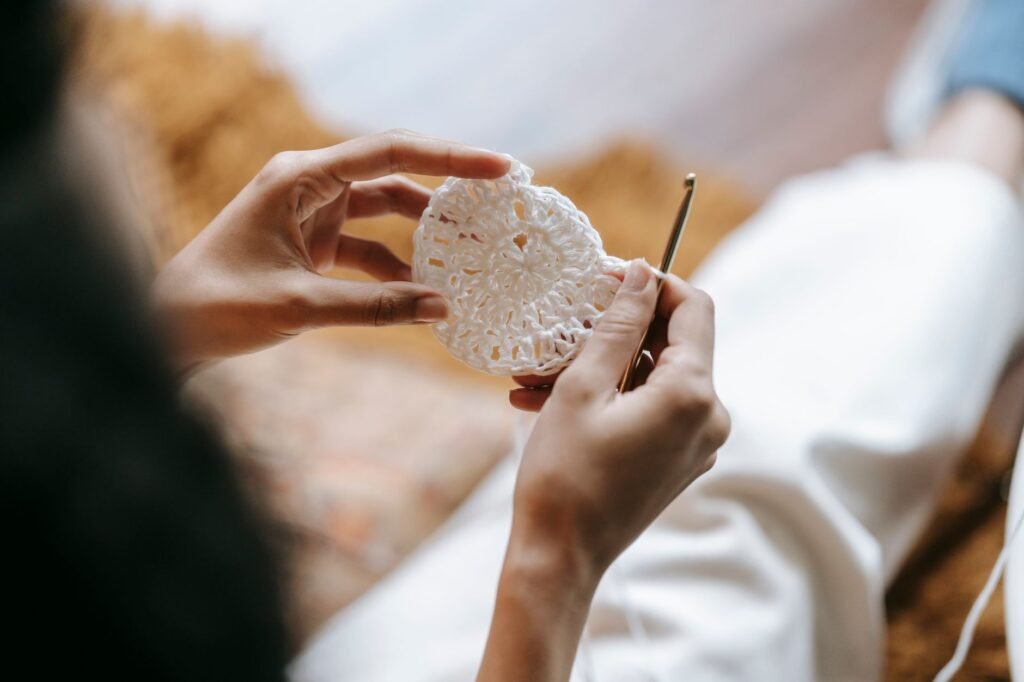
To understand why, it helps to look at what a single crochet stitch actually requires. With each stitch, the crocheter inserts a hook into a stitch or space, catches the working yarn, and pulls a new loop through the loop (or loops) already on the hook. That single hook has to move in three dimensions – forward into the stitch, around to catch the yarn, and back out again, all while the crocheter’s other hand manages tension on the yarn and controls exactly where the hook goes next.
That “grab and pull through” motion, repeated with constant small adjustments, is very different from what a knitting machine or a loom does.
Why Knitting and Weaving Are Different
Knitting machines work because knitting uses many “live” loops at once, sitting on a row of needles that can all be manipulated together in a repeating, predictable motion. A knitting machine essentially automates a simple, repetitive action across dozens of needles simultaneously.
Looms work because weaving is about lifting and lowering threads in a fixed pattern, then passing a shuttle through – a mechanical process that repeats in a very structured, geometric way.
Crochet has none of that structural repetition to exploit. There is typically only one live loop on the hook at a time, and the hook’s path through the fabric changes constantly depending on the stitch pattern, the shaping, and decisions the crocheter is making in real time (increasing here, decreasing there, changing stitch height, turning a corner). Engineers who have looked into automating crochet consistently run into the same wall: the single-hook, one-loop-at-a-time motion, with its constant tension control and three-dimensional maneuvering, has not been successfully replicated in a commercial machine.
The Nuance: What Machines CAN Fake
This is where things get a little tricky, and it’s worth being precise about it, because plenty of items are sold using the word “crochet” loosely.
Machines can produce trims, braids, and edgings that visually resemble crochet – narrow decorative strips used on the edges of garments or linens. Some knitting machines can also be programmed to create stitch patterns that mimic the look of certain crochet textures, especially simple, repetitive ones like granny-square-style motifs printed or knit into fabric.
What machines cannot do is freeform, true crochet: hand-shaped three-dimensional pieces (like amigurumi, a Japanese term for crocheted or knitted stuffed creatures), garments built stitch-by-stitch with hand-controlled shaping, or the actual loop-through-loop stitch structure that defines crochet fabric.
So in practice, when you see “machine-made crochet” for sale, what you are almost always looking at is one of two things: a knit imitation that has been styled to look crochet-like, or a machine-made trim/braid used as an accent. It is essentially never true, freeform hand crochet, because that process has no machine equivalent.
How to Spot Real Crochet vs. a Fake
If you are shopping and want to know whether something is genuinely hand-crocheted, a few things to look for:
Look for slight irregularity. Real handmade crochet, even from a skilled maker, has small natural variations – a stitch that is very slightly taller or looser than its neighbor, tension that shifts almost imperceptibly across a large piece. Machine-made knit imitations tend to be perfectly uniform, because a machine repeats the exact same motion every time.
Check the stitch structure itself. Genuine crochet has a distinctive loop-through-loop structure you can trace with your finger – each stitch is a small knot-like unit sitting on top of the row below it. Knit fabric, by contrast, is made of interlocking rows of loops that stretch more and have a smoother, more uniform “V” pattern. If you gently pull on the fabric, true crochet generally has less stretch and more structure than knitting.
Be skeptical of suspiciously low prices paired with claims of “handmade.” True crochet takes real time – even a simple dishcloth can take an hour or more, and a garment or blanket can take many hours across days or weeks. If a “handmade crochet” item is priced like a mass-produced import, it is very likely a knit imitation or a machine-made trim, not true hand crochet.
Look at the back or inside of the work. Handmade crochet often shows small, honest imperfections on the reverse side – yarn ends woven in by hand, slightly uneven joins. Machine-produced items tend to look identical from every angle because they came off a uniform process.
None of this is about shaming budget-friendly imitation pieces – they have their place. It is simply about knowing what you are actually buying, and giving credit where it is due.
Why This Actually Matters
It is easy to treat “handmade” as a marketing word, tossed around loosely on product listings. But with crochet, it is not a marketing word – it is a literal, technical fact. There is no factory floor, anywhere in the world, quietly cranking out true crocheted blankets and sweaters the way there is for knitwear. Every stitch in a real crocheted piece passed through someone’s hands, one loop at a time, guided by their attention and their tension and their choices about exactly where the hook goes next.
That is the whole quiet magic of this craft. When you pick up a hook and start looping yarn, you are doing something that, as of today, still cannot be replaced by a machine. That is worth feeling proud of, whether you are making your first wobbly single crochet swatch or your fiftieth blanket. Every stitch is genuinely, provably yours.
Frequently asked questions
Why hasn’t anyone invented a crochet machine?
Because crochet works with only one live loop on the hook at a time, and the hook has to move in three dimensions while a person constantly adjusts tension and decides where to insert it next. Knitting and weaving machines succeed by repeating a simple, structured motion across many needles or threads at once – crochet has no equivalent repetition to mechanize.
Isn’t some “machine-made crochet” sold in stores real crochet?
No. What’s sold as machine-made crochet is either a knit imitation styled to look crochet-like, or a machine-made trim or braid used as an accent. True freeform hand crochet, with its actual loop-through-loop structure, has no machine equivalent.
How can I tell if something is really hand-crocheted?
Look for slight irregularity in the stitches, check for the distinctive loop-through-loop structure you can trace with your finger, be skeptical of low prices on claimed “handmade” items, and look at the back of the work for small honest imperfections like hand-woven-in yarn ends.
Is it fine to buy machine-made imitation crochet?
Yes – the article isn’t about shaming budget-friendly imitation pieces, since they have their place. It’s simply about knowing what you’re actually buying and giving credit where it’s due.
— NoraEvery pattern hand-tested